Thursday, April 7, 2011

Character Design Basics


This is the cast of "Seinfeld."...now what's weirder, the fact that I just reduced the four main characters of a TV show down to basic shapes, or the fact that even if you've only seen commercials for the show, you know which character is which shape? This is not a coincidence. While I don't know this for a fact, it's very credible that the creators and casting directors put a lot of thought into the basic shape of the cast members.
This was all pointed out to me a few years ago in art school. The basics of character design rely on the human necessity to find visual distinction between people. At the most basic level, you have distinctions of race, gender, age, and physical disposition. I have been thinking about this recently because my roommate and I have been watching the show "Community." The cast of characters in it has a lot of visual variety in these basic levels.
Quick note before I go on: this has NOTHING to do with racist or sexist motives. It is an inherent quality in the human psyche to distinct people by gender and race, as well as age and physical disposition. On a subconscious level, when the mind is trying to recall a person, these factors simply come up first.
In "Community" the two people that share the closest resemblances on these levels are the two young girls Britta (foreground) and Annie (middle row). They're both young, white, physically fit girls. But Britta is a blonde, and Annie is a brunette: one of the primary distinctions that guys make when comparing girls. Variety is obviously not on just the basic levels, but extends into clothing style, hair, height, and all the other factors that make no two people exactly alike.
Variety is necessary in character design because an audience has to instantly 1) connect faces with names with personalities and 2) find someone in the cast that they can relate to. Variety can be something that is a part of the story, too. The original Star Wars trilogy emphasized the variety of species and character background in the Rebellion with the uniformity of the Empire. Some stories have an agenda of political correctness, which is fine, but good luck sneaking it past the audience without them catching on very early.
Sometimes, though, variety in character design isn't completely possible. With as much variety of characters in "Lord of the Rings," when I saw the first movie for the first time (having not read the books) I was so blown away by everything the film was showing me, that I sometimes got Aragorn and Boromir confused. Viggo Mortensen and Sean Bean were both perfectly cast, and looked exactly as Tolkien described their characters, and their similarities are a part of the story, but I just needed to see the film again to understand how different they both were. In other cases, factors like location and time period don't allow for visual variety. There's no two ways about it: a World War II story about US soldiers is going to have a bunch of white, physically fit, guys who are all basically the same age, and wearing the exact same clothing. The TV series "Band of Brothers" had this tremendous hurdle to deal with on a large level, and so lots of focus was put into the distinctions of personality between characters.


Wednesday, April 6, 2011

It's *cough cough* Abstract Art

From Here to Eternity? Gone with the Wind? Casablanca? Pretty Woman? None of the above.
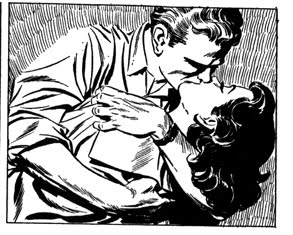
Leonard Starr's "Mary Perkins: On Stage" is a soap opera newspaper comic strip from the sixties. Starr's work is incredibly detailed and rendered very realistically. He put tons of effort into not only making his characters unique, but his backgrounds as well. So, a panel like this is rather unusual for him, with the background completely obliterated by radiating lines. So why would he abstract a background?
Abstracting a background is one of the things that comics can do that is rather unique to the art form. Film can drop focus on the background, but anything more than that and it's a little alien to the medium. Comics have the luxury of letting the artist establish an environment, and then, when necessary, abstracting it--or holistically dropping it--for the sake of drawing focus on the characters. There are actually several reasons to do this, and several ways. The reason I'm focussing on is when a scene's emotion needs to be the central focus. Notice how the lines are radiating from the couple, as if their kiss has so much energy it's affecting the world around them. In this other example, a panel from Archie Goodwin and Al Williamson's "Secret Agent Corrigan," Adrienne's shock at what Burke just said is emphasized by the jagged and disrupted brush strokes around her. In my example, the woman's sadness is emphasized by the darkened background.


Monday, March 28, 2011

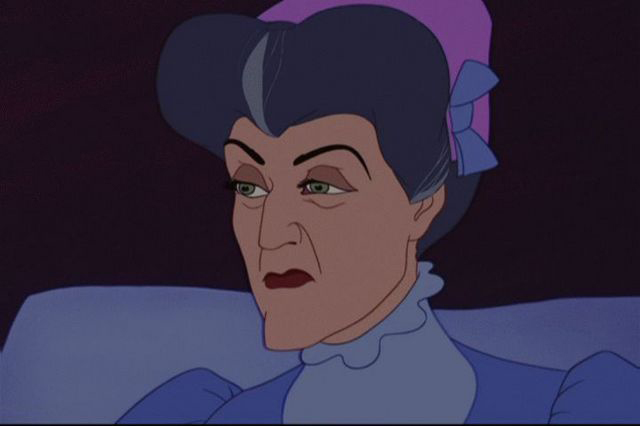
Mother Knows Best


I recently watched the film "Saboteur," and it had one of Hitchcock's favorite archetype characters: the dominating mother. Probably my favorite example of it is actually in the film "Notorious."
The dominating mother is not frequently used in stories, but it has incredibly powerful irony. First off, the mother image is usually one of love and life. A good mother is selfless in her care for her children, whom she literally gave life to. There are many cultures and mythologies which have some religious significance attached to the mother figure--often times connected with the creation of the world and/or the human race. This, combined with social etiquette, often gives mothers a sense of reverence and respect ("you don't talk that way to your mother!"). Mothers are often paired with images of life, plenty, and abundance because they are birth-givers. A good mother wants what is best for her children, but allows her children the freedom to choose their own path.
But these dominating mothers twist every aspect of these classical characteristics. These characters are entirely selfish, and grant false love and care only when they benefit from it. They gave life to their children--or high standing to their underlings--but her children are forever indebted to her for granting them this 'favor.' She is above everything, and rules over everyone with an iron scepter. She has wealth and abundance, but it is not because she gave birth, rather, she took the things she has. One of her greatest abilities is her knack for manipulation; she will twist her underlings into doing what she wants, because they think they want it too.
My favorite part about this character, is another level of irony. She remains in power mainly because she commands respect and obedience, which would be due to her if she were a good mother. Because of her position, she guilts her children into treating her like a birth-giving, selfless, loving mother. Everyone beneath her knows she's manipulative and selfish, but they won't dare question her because since she 'gave' them life or high standing, she can take it away. Though this mother is so obviously twisted, people treat her with love solely on the basis of the fact that she is technically a mother.
It's a shame that films, comics, tv, etc. don't use this interesting character type more often. In stories where it might be possible, for one reason or another, the character is much more commonly the mafia godfather character. You can always tell a lot about a person by how they treat their mother (guys especially). This is because when a person is around their mother, they are more prone to reverting back to their childlike/childish ways: ergo, their more natural state. Fathers have this same power, but it's much more obvious with mothers, probably rooting back to their birth-giving nature. Even good mothers have an incredible power over their children: no person of any standing doesn't cringe a little when their mother shouts at them, using their full name.


Wednesday, March 23, 2011

They're Not Moving, You Just Think They Are

I've recently picked up a commission to draw a dancing couple. I'm happy for this, mainly because I really love drawing dancers. Any type of extreme movement gives the body a lot of energy, but the illustrator is at a disadvantage because illustrations are static. Movement can--at best--be suggested.
Movement is a funny thing, because if you look at a still image of a person in the middle of just about any movement, but especially extreme ones, they look really, REALLY, weird. Reasons could be because weight is shifting, the basic body parts haven't arrived at their destination, or it just looks unnatural. The artist has to choose a part of that movement that not only tells the audience what the movement is, but also looks dynamic and interesting.
In these dancing sketches, I started developing a pose that is more towards the end of the motion: the guy is pretty much finished moving and is striking a pose, and the girl is pretty close to being done. The energy is high for both of them, but they are done moving. To create some more energy, and a more immediate sense of motion, I started playing around with the clothes they're wearing. Dancers commonly wear flowing clothes for this very reason.

Monday, March 21, 2011

Baby's got Back

You ever notice Iron Man's back? In the movies, the design of his armor gives his lower spine this vaguely inhuman curvature which is really slick. I couldn't find the perfect picture of this, but if you've seen the Iron Man movies a few times, you probably know what I'm talking about. Emphasizing this muscle development is not exactly common, mostly because characters are usually turned toward the viewer. It's also not common with male characters, because emphasizing an s-curve shape is much more typical with female characters (I'll probably get into that in another post). I think the reason it's done, though, is because 1) superhero type male characters are typically barrel-chested, and these muscles (the Latissimus Dorsi, according to my anatomy chart) are very important for that and 2) it gives the character a nice butt, which--let's be honest--makes viewers look.
My drawing was of the popular Green Lantern character Hal Jordan. He's turning to the side, but while I was drawing the picture, I thought of this.


Saturday, March 5, 2011

Just CHEW the Scenery!

One of the traits that cartoons are known for is the exaggerated expressions. Daffy here is running in terror, obviously. Now, aside from the fact that ducks don't really run, or have hands, the main anatomical feature that is exaggerated is his mouth. No mouth--human or duck--can stretch that much. But that's one of the great things about cartoons: you can stretch and bend anatomy to heighten emotion.
This might seem restricted to the abstracted world of Looney Tunes or Disney. But the same principles can be applied to much more realistic styles of drawing. Though not to the extent of cartoon characters, realistic anatomy can be stretched or squashed to a minimal degree to communicate an idea. I've been applying this in my drawings recently, specifically with some Street Fighter sketch cards I've been working on. Here, Blanka's and Balrog's mouths are both open a little wider than the actual human mouth can stretch, and I pulled the lips at the corners a little further (theoretically adding muscles to the facial anatomy; I personally have some pretty flexible lips, and even I can't pull my mouth exactly like this). If you don't believe me, take a look at the reference photos I was using. Under close examination, you'll see what I'm talking about.
The purpose of this was to show some real rage in both characters. Bearing teeth is a worldwide human gesture to show anger: the more teeth you show, the angrier you can look.


Sunday, January 16, 2011

The Best Offense is a Good...Weight Distribution

I had just drawn a pin-up of Green Lantern, and wanted to do another. So I went back to a sketchbook page with lots of different pose ideas roughed out and saw this one. I sketched it out at 6"x9", and scanned it in. Once I started pencilling it out on its full size, I started to feel like the image didn't have enough energy or power to it.
My first thought was that it was a matter of line work, and that it might be solved as I draw it out. But just in case, I set up my camera and struck the pose with some energy behind it (quick movements and flexing muscles--how the character would theoretically be moving).
At first, the result frustrated me. When taking the picture, I put my weight on the wrong foot and the pose was completely inaccurate. Then I realized that my photo was better than my drawing.
The original pose is actually not a bad or incorrect pose. The problem was with the fact that I was trying to communicate energy and power, and that pose wasn't doing it. It's because the weight was distributed on the back leg, rather than the front one. The layman might not think that an important issue, but ask any dancer, athlete, or fighter, and they will tell you that distributing weight on one foot versus the other changes a lot. One of the main things that weight distribution effects is direction. You can't move in any direction without putting your weight towards that direction. In this case, Green Lantern is blasting an energy bolt out of his power ring. I want him to look like he's making a powerful attack. With his weight pushed back, he looks like he's defending or retreating, whereas with it pushed forward, he's really moving forward. This pose is essentially a punch. An energy blast from the hand will have more power behind it if the body is a part of that blast.